The Road Safety Trust marks a decade of impact and examines the future of road safety
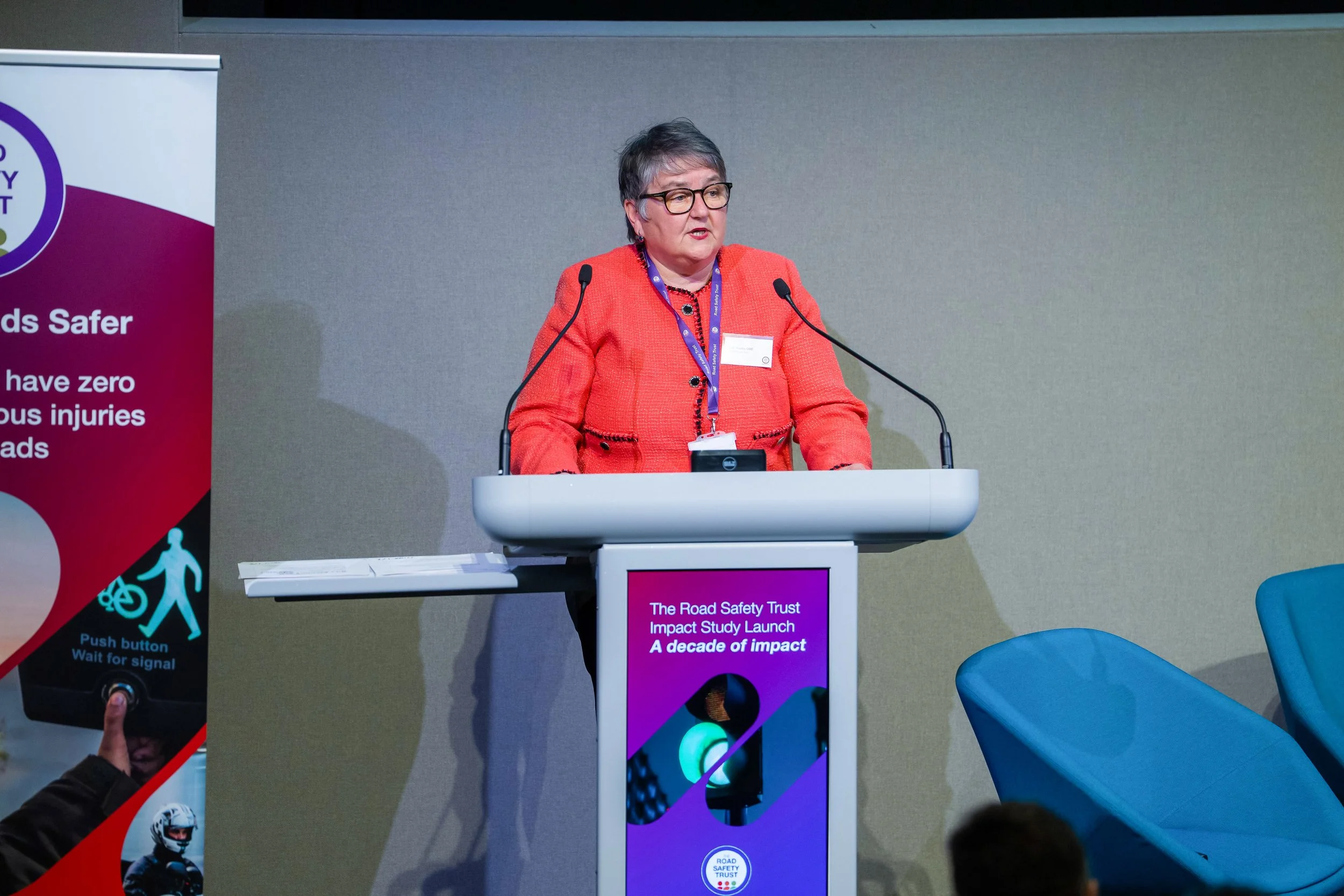
Leaders from the police, the NHS, and the transport sector met at the Wellcome Collection this week (Wednesday 25 March) to mark the launch of The Road Safety Trust’s landmark impact report.
The event was a chance for the people behind the UK's most innovative safety projects to share what they’ve learned and discuss how to stop deaths on our roads. The room was filled with experts discussing everything from new road markings for motorcycles to linking police and NHS data to improve emergency care after a crash.
The launch opened with a video address from Lilian Greenwood MP, Parliamentary Under-Secretary of State (Minister for Local Transport), recognising the Trust's decade of contribution. This was followed by a keynote from Ruth Cadbury MP, Transport Select Committee Chair, who discussed parliamentary scrutiny of the Road Safety Strategy published in January 2026.
A key focus in discussions was on how designing for the most vulnerable road users unlocks safety benefits for everyone. Wheels for Wellbeing Campaigns and Policy Manager Dr Kay Inckle highlighted the need for equitable access to active travel, while Transport Scotland Project Manager David McKenzie shared insights from Trust-funded project PRIME, which uses innovative road markings to improve motorcycle safety in rural areas.
The event also addressed the era of autonomous vehicles and digital innovation, featuring Waymo Director of Safety Science and Management Trent Victor and Dr. Lisa Dorn, Director of the Driving Research Group at Cranfield University, who discussed the design of behavioural interventions in an automated world.
In a concluding fireside chat, Jo Shiner KPM, Sussex Police Chief Constable, offered a policing perspective on the shift toward evidence-based prevention. She emphasised the Trust’s role as a vital partner in ensuring future enforcement is targeted and measurable in terms of lives saved.
Lilian Greenwood MP, Parliamentary Under-Secretary of State (Minister for Local Transport), said: “Many of the research programmes and pilots funded by the Trust helped build the evidence base for the government’s new Road Safety Strategy, Britain’s first in over a decade. The Trust has spent ten years proving what collaborative, evidence-led work can achieve. That expertise and commitment will be invaluable as we move forwards with our renewed focus on safer roads for all.”
Paul Steinberg, Deputy Chief Executive of The Road Safety Trust, who hosted the event said:
“Today showed what’s possible when the right people come together – police, policymakers, researchers, practitioners and industry – all focused on reducing deaths and serious injuries on our roads. With the Government’s Road Safety Strategy consultation underway, this is the right moment to celebrate the Trust’s first decade and turn evidence into action. The Trust has built a robust evidence base. Now it must be applied.”
Insights from the Frontline of Innovation
Central to the discussion was the role of Trust funding in bridging the gap between theoretical research and frontline practice.
Professor Tim Nutbeam, Consultant in Emergency Medicine and Prehospital Emergency Medicine at Plymouth Hospitals NHS Trust, commented: "Innovation in post-collision care has historically been limited by a lack of evidence and the persistence of long-standing dogma. Our work has shown that by bringing together multidisciplinary teams and applying rigorous science, we can challenge those assumptions and generate meaningful, practice-changing insights. With the support of The Road Safety Trust, this has translated into real-world improvements in how we care for people after a crash, demonstrating that high-quality science not only can be done in this space, but when it is done well it can save lives.”
Dr Phil Hyde, Principal Investigator at the University of Southampton, highlighted the transformative nature of data integration:
"With large grant support from The Road Safety Trust the PRANA programme has achieved a world first proof of concept for regional linkage of police road collision data to NHS ambulance and hospital data. The RST’s support has been utterly transformative and fundamental to enabling this leap forward in road safety data insights. The newly created linked road safety data asset is now in a position to move from regional to national scale."
Dr Mazdak Ghajari, Reader in Biomechanics at Imperial College London, discussed the impact on consumer safety:
“Thanks to the generous support by The Road Safety Trust, we were able to translate our trans-disciplinary research on brain injury biomechanics and helmet testing to an accessible rating programme. HIPER provides objective information about impact protection of helmets. It bridges a crucial knowledge gap for consumers and encourages evidence-based improvements in helmet design and protection.”
Informing National Strategy
Another theme of the day was the role of Trust-funded research in directly informing national policy on road safety.
Dr Nick Reed, Founder of Reed Mobility, noted: "The impact of projects funded by The Road Safety Trust is demonstrated by their outcomes being woven through the government's recently published Road Safety Strategy. Looking ahead, with the strategy as a national framework for coordinated action, the Trust can act as a force multiplier supporting critically important road safety initiatives that might otherwise be challenging to fund through other means."
Impact Report
With a portfolio of more than 120 projects, Trust-funded research and interventions now form a cornerstone of the UK’s evidence base for safer roads across the UK.
The findings are part of an independent study published at the event from world-leading transport consultancy Systra looking at the Trust’s impact across many aspects of road safety – from engineering new road layouts and testing safety equipment, to educating young drivers and improving police enforcement.
Findings from the report include:
Driving actionable change: 53 of the 74 completed projects assessed showed clear evidence of current or future positive impacts on road safety.
Unlocking potential: 98% of surveyed grantees (40 out of 41) stated their work was unlikely to have proceeded without the Trust’s financial support.
Targeting unexplored areas: The evaluation found the Trust frequently funds projects that focus on critical safety issues that lack clear ownership by other organisations.
The Road Safety Trust’s next Large Grants round will open shortly after Easter. With a dual theme of preventing harm linked to drug driving or motorised riding, and of safer vehicles – and with total funding of £750,000 available – it will continue the Trust’s investment in practical, lifesaving innovation.
The full Impact Evaluation Report is available here.

26 March 2026